

We may earn a commission for purchases using our links. Learn more.
If you've ever heard an unexpected sound and hurried to check your baby monitor, only to discover you still have two sleeping angels and that nobody has to be lulled back to sleep, you're likely running on little sleep as it is.
Then, there are the times where you check the monitor and one of your twins isn't where they're supposed to be. When one of them comes running out of their room in the wee hours of the morning, the other usually isn't far behind.
When one of them comes running out of their room in the wee hours of the morning, the other usually isn't far behind.
I think it's because the one who woke up second hears the hurried footsteps of the sibling who woke up first, and, still 90-percent-asleep, figures their life is in imminent danger, launches out of their bed, and follows furiously (somtimes with eyes still closed) in their twin's footsteps to where safety must surely be.
Luckily, in those few instances, we've intercepted them before the one with closed eyes makes it more than a step into the hallway from their bedroom.
Early-morning wake-ups are a part of toddler life. If you're lucky, those early morning wake-ups don't involve one twin waking up their sibling while they're trying to catch some Zs.
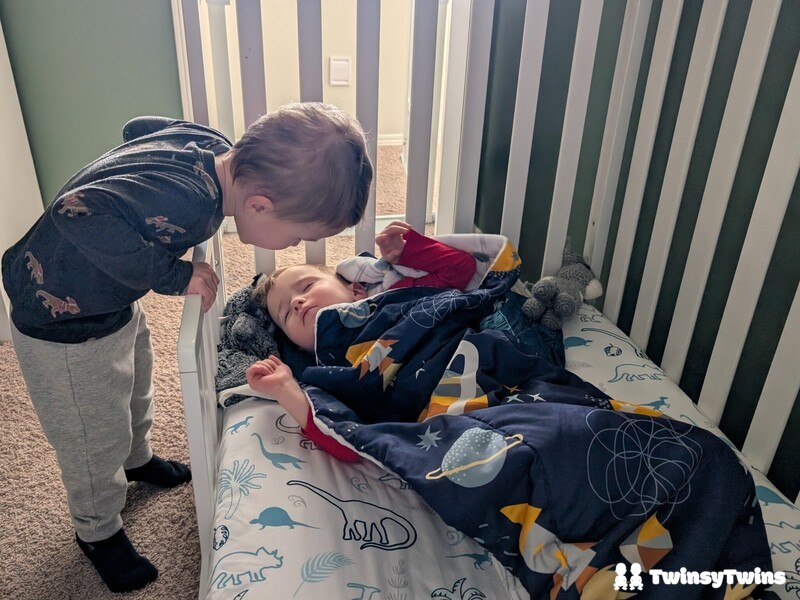
We're fortunate that OUR early mornings don't start at 5:00 am. Whichever sibling wakes up first is usually excited to start the day and figures everybody else must be up-and-at-'em already, so comes to find out where everybody's at. Fun fact, they're still snoozing under the covers the majority of the time.
If you find yourself wishing your toddlers would sleep in just a little bit longer, incorporating sleep training clocks into your twins' bedtime routine could help them understand when it's time to stay in bed, so everybody can get a bit more sleep before it's time to face the day.
How sleep training clocks work

When implemented at the right time, sleep trainer clocks can play an important role in building a healthy sleep routine.
While you've probably had a bedtime routine in place since your babies were four or five months old (we incorporated one when we did sleep training with our twins), you don't want to start using a sleep trainer clock too early. If your babies are six months old, or even one year old, they won't yet be able to grasp the concept of why the clock is there and what purpose it serves.
Most children catch on to the concept when they're around two years old, and anytime after that milestone would be a fine time to introduce a sleep trainer clock to their bedtime routine.
There's a certain science to developing a sleep trainer clock that kids can understand, and when you use one as part of a consistent bedtime routine, it can help young kids fall asleep, stay asleep longer, and build healthy sleep routines.
"A sequenced routine using a sound and light machine—with distinct lights and sounds for the bedtime process, followed by sound alone throughout the night—gives your little one a clear, multi-stage roadmap to follow each night," says pediatric sleep expert Dr. Natalie Barnett.
In her role as vice-president of clinical research at Nanit, she leads their internal sleep and development research programs and initiated sleep research collaborations to better-understand pediatric sleep.
"When a toddler rouses between sleep cycles and no light is present, that absence becomes its own cue; a non-verbal signal that it's still sleep time," says Dr. Barnett. "Some families choose to use an 'okay to wake' light that can turn on at a specific time, before which the toddler needs to try to go back to sleep and stay in bed.
"It can be very hard for toddlers to interpret a clock, but they can definitely learn to understand a visual cue," she adds. "A consistent, gentle 'okay to wake' light can replace an abstract idea with something concrete, and, with repetition, that signal can begin to regulate morning waking behavior."
Three sleep trainer clocks to help your twins know when it's time to wake up
TwinsyTwins Shop

1. Groclock Sleep Trainer Clock by Tommee Tippee
Shows Analog & Digital Times
This is the Groclock by Tommee Tippee. It's a sleep trainer clock that helps your toddlers understand when it's time to sleep (read: stay in bed to avoid early-morning wake-ups) and when it's time to rise. It tells the time with colors (orange for daytime and blue for nighttime) and pictures (a cute owl named Ollie makes this clock fun for your kids to interact with, and as time counts down to the set wake-up time, the clock faces shows Ollie sleeping while stars and hearts slowly disappear one by one, until it's time to wake up, and then Ollie the Owl wakes up and the color switches to daylight mode. This clock incorporates both analog and digital times, so that as your kids grow, they can learn to tell time both ways. You can set individual wake times for mornings and naptimes (plus for weekdays versus weekends), and it also has an optional alarm mode, so you can set an audible wake-up cue, too, if you like (and the alarm can bet set to go off at a different time than the time the clock faces switches from nighttime to daytime mode). It's USB-powered, so it needs to be generally close to an outlet, or you need to run an extension cord from the wall to wherever you'll have it set up. I was worried this would be an issue, but the best place for it to be set up was on our twins' dresser, so there was no visible cord for any little hands to grab. You can adjust the brightness, making it higher or lower or can even turn it all the way down, so there's no light source during overnights, if it bothers your little ones while they're sleeping.
TwinsyTwins Shop

2. Sound & Light Machine by Nanit
Combines Sound & Light
This is the Sound & Light Machine by Nanit. It's a smart baby product that combines a sound machine—with 11 different soundscapes, including white noise—with a nightlight to help little ones fall asleep, stay asleep longer, and build healthy sleep routines. The nightlight is customizable, so you can pick whatever color (and also whichever brightness) helps set the mood for your little ones' sleep sessions and wake-up routines. You can also save your favorite settings, so you don't have to reset things each day, and the sound and light settings can easily be adjusted on the unit or within Nanit's app. This portable machine has a rechargeable battery (up to eight hours, but it can also be plugged in with a power adapter if you're not on-the-go), a dimmable digital clock, and it features cry detection, so it will alert you if your babies need you.
TwinsyTwins Shop

3. Rest+ Baby & Kids Sound Machine, 2nd Gen by Hatch
Has Optional Access to Music & Stories
The Rest+ Baby & Kids Sound Machine by Hatch is a smart sleep assistant for your babies and kids. It's a Wi-Fi-enabled white noise machine that has a built-in nightlight, and you can customize the light and sound combinations to keep their bedtime routine on track. This device has a Time-to-Rise alarm clock feature that lets your kids know if it's still too early to get out of bed or when it's alright to get up and face the day. It also has a Time-for-Bed feature, which can give your kids consistent cues for when it's time to wind down for naptime or bedtime. You can adjust settings and set schedules through the accompanying app, and you can control the volume or nightlight with easy access buttons on the machine. This unit also has an optional subscription for Hatch+, which allows you to access music, stories, and personalized goodnight notes to help your little ones wind down and fall asleep. You get a free trial of the services with purchase, so you can try it out and decide if it works for the bedtime routine in your household).
Turn your super kiddos into super sleepers

When we incorporated a sleep training clock into our bedtime routine, our twins took to it right away, and they immediately understood the difference between nighttime mode and daytime mode on the Groclock by Tommee Tippee.
The first morning after we set it up together, they yelled "Mom!" and at first, I was worried it was because something was wrong, but then when I answered them, they exclaimed, "The light is yellow! It's morningtime!"
It was so cute to see them so excited about the time and when it was time to go downstairs.
Now, even if they wake up before the clockface colors changes, they've started playing quietly in their room for a few minutes, will whisper quietly to each other because they recognize it's still time to be quiet, or will roll back over and try to go back to bed because they see the clock is still on nighttime mode.
Then, when it swtiches over to daytime mode, they know it's time to get up and get into our daily routine.
They've also taken an active role in making sure their clock is swtiched into bedtime mode before they crawl into bed, so it's not only teaching them about daytime and nighttime, it's also giving them a sense of responsibility, which is wonderful to see.
Whether it's when they wake-up or as they get ready to jump into bed, our twins are interacting with and learning from their sleep training clock, and it's been a great addition to our daily routine.
Did you use / are you planning to use a sleep trainer clock to help your twins recognize when it's time to get out of bed (or, more importantly, when it's time to stay in bed?). Let us know in the Comments section below or connect with us on Instagram to share your thoughts!
Read more

NextNap Tool from Nanit Predicts Personalized Nap Times for Your Twins
When you're a parent of newborn twins, you become a scheduling master pretty quickly. You keep your babies on the same schedule, as much as you reasonably can, because, let's be serious, it's just not always possible to keep your new little humans on the exact same schedule all the time. But when the stars align and your babies' nap schedules align, too, you can take advantage of a...

This Portable Pro Baby Monitor is Perfect if You’re Welcoming Twins
When you have two newborn babies at home, it can be twice as nerve-racking because there's always the chance that something could happen to not just one of them, but both of them—at the same time. Let's face it, you need to sleep at some point, even if those moments are abundantly scarce and the quality is incredibly inadequate. Having the right system in place for keeping an eye on...

This is How Many Hours of Sleep Your Newborn Twins Need
As a parent of newborn twins, you may be wondering how many hours of sleep your babies actually need in order to thrive. Newborn babies feed around the clock, so they sleep in small but frequent chunks. In general, you can expect your babies to sleep for about eight or nine hours during daytime hours and for about eight hours during nighttime hours...but the sleep will only come in two...

Follow These Practices to Promote a Safe Sleep Environment for Your Babies
October is Infant Safe Sleep Month. It is also Sudden Infant Death Syndrome (SIDS) Awareness Month. Together, they aim to raise awareness of sleep-related infant deaths and promote a safe sleep environment for babies around the world. Keeping your newborn babies safe is any parent's top priority, but it can be hard (read: impossible) to keep a close eye on your little ones when your...