

You've probably heard the nursery rhyme that tells us what girls and boys are made of.
In case you need a reminder, this is what it says about girls: "Sugar, and spice, and everything nice, that's what little girls are made of."
And this is what it says about boys: "Snips, snails, and puppy dogs' tails, that's what little boys are made of."
One descriptor is flattering; the other, not so much. But talking about how girls and boys differ gets the mind turning.
I know people who have young daughters who play together nicely and work on coloring and crafts and relaxing games where they take care of each other. It contrasts quite sharply with my own personal experience with my twin toddler boys.
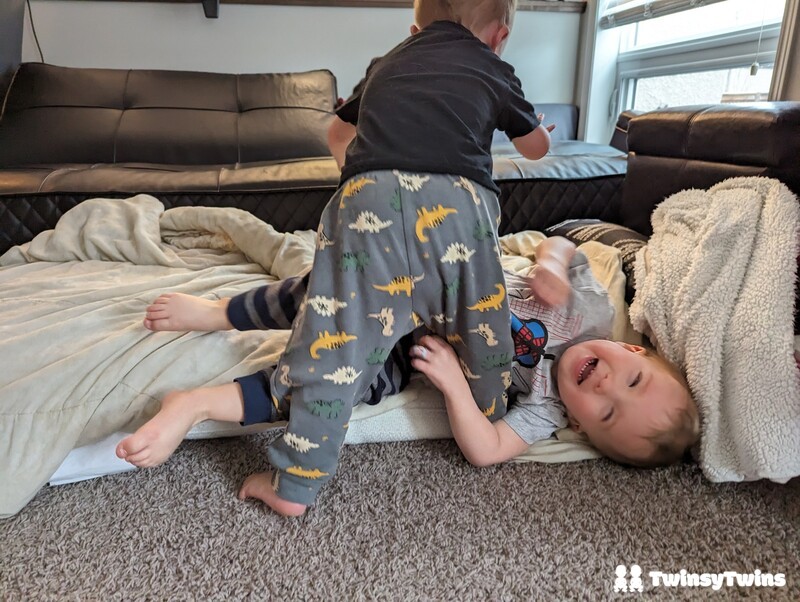
While our sons do play nicely sometimes, more often than not, it feels like we're hurrying across the room to separate them or trying to stop them from fighting, grabbing, or hurting each other.
But what if the roughhousing we perceive as violence or a threat between our twins isn't actually aggressive behavior? What if it's them trying to fulfill a sensory need that they don't know how to satisfy?
But what if the roughhousing we perceive as violence or a threat between our twins isn't actually aggressive behavior? What if it's them trying to fulfill a sensory need that they don't know how to satisfy?
Granted, some toddlers really do play roughly, to the point where it can become out-of-control or aggressive. But, more often than not, when they start to wrestle or play less-than-gently, they're doing it because they're seeking deep pressure input through proprioceptors to calm and regulate their nervous systems.
Proprio—what?
If you've got some busy toddlers who tend to get a bit rowdy and you're seeking solutions to calm the chaos, proprioception could be the starting point.
So, what exactly is proprioception?
It's our sense of body awareness and is what helps our brains know how our muscles and joints are moving. It helps us to know where our body and limbs are, how much force to use (i.e., how hard or soft to push or pull something), and how to move smoothly without needing to look.
According to Griffin Occupational Therapy, "each time we move, the propriocepetive feedback from our muscles and joints tells our brain where our body is. This includes any time we move our arms, legs, hands, feet, neck, or spine. Even when we are still, the stretch of the muscles, or lack of stretch, and the joint position tell our brain where we are."
Toddlers seek proprioceptive input because it's crucial for coordination, balance, and completing everyday tasks (e.g., motor skills like walking, running, or jumping; managing stress and anxiety; and improving focus and attention). So, when you see them getting rough with each other, it's not necessarily out of anger but is instead out of a need for sensory regulation and deep pressure input.
Instead of jumping into punishment mode and penalizing what appears, on the outside, to be wreckless, dangerous, or downright bad behavior, pause for a moment and try offering a solution that gives your high-energy twins a therapeutic outlet for this sensory need.
Signs your twins may be seeking proprioceptive input:
According to the Toronto Children's Therapy Centre, a child may be seeking proprioceptive input if they:
- Bite or chew on inedible objects (e.g., their sleeve).
- Enjoy roughhousing.
- Throw themselves heavily on the floor.
- Sit on hands or with knees tucked under themselves.
- Hyperextend or compress joints.
- Write with excessive pressure and hold objects very hard.
- Hit body parts together or against things.
Put them to "work"

If you notice these signs or feel as if your twins have gone from "regular mode" into "chaotic, what-just-happend mode" in a matter of seconds, they could be seeking proprioceptive input.
Don't dole out discipline in the form of timeouts that won't get the message across or stop roughhousing altogether. Instead, let it play out, carefully.
Put them to "work" and teach them constructive games they can play to calm their nervous systems.
What occupational therapists call "heavy work" can help your toddlers take their high energy down a notch. These activities can help your energetic little ones develop their proprioceptive processing and regulation by encouraging them to push or pull against resistance.
Completing these actions allows them to find the sensory input they're seeking and causes their body to release serotonin and dopamine (AKA, calming, "feel good" neurotransmitters), which then help to calm their nervous system.
"Heavy Work" Games You Can Try at Home
- Push (or Pull) That Boat: Grab a laundry basket. Your twins will instinctively want to take turns climbing into it. Have them sit on their butt in the basket (on the main floor and away from any stairs), and then have the other twin push or pull the weighted basket across a carpeted floor. This simulates a "weighted sled" push, and it exhausts their large muscle groups safely. When they're done pushing the boat, have them switch positions and do it all over again.
- Gettin' Groceries: Fill a toddler-sized backpack with some groceries that they can carry around, or have them lug appropriately sized containers of pet food around. This helps them practice carrying weighted objects safely, so they can learn their limits.
- Stack 'Em Up: Have your twins take a pile of books and stack them on top of each other to build a tower. This activity helps them move weighted objects within safe limits, so they can learn how to lift things carefully.
- Knock Over That Wall: Challenge your twins to face the wall, put their hands against it, and try to push it over. Not only will they be impressed you're giving them permission to destroy the house (in their minds), this game provides intense isometric feedback without any actual risk of property damage.
- Walk This Way / Jump Around: Get your toddlers to do mini races across the room, where they do "bear crawls" or "crab walks." These animal-inspired walks engage their core and limbs, which provides the sensory input they crave from wrestling in a structured and safer format. Or, have them climb on playground equipment or jump on a mini trampoline; movement-based activities like these also fulfill this sensory need.
- Hug it Out: When all else fails and everybody's getting too hyped up, get your twins to practice who can give youor each other the tighter hug. A good, firm hug allows them to get that deep pressure input in a safer way.


Fulfilling deep pressure input

Sometimes, our twins seem to recognize they need deep pressure input, and they seek ways to fulfill this sensory need on their own (or with the terrifyingly creative help of their sibling).
Like, the time I rounded the corner after grabbing a load of laundry to discover one of our twins had silently scaled halfway up the wall (as you can see in the above photo) in a few scarce seconds. He was beyond thrilled (I was, too, once he was back on solid ground).
Other times, our twins may not notice or know how to satisfy the proprioceptive input they're seeking. Whenever these moments pop up, and I can sense things are going to get chaotic quickly, I tell our twins, "Quick, I need your help!"
Saying "quick" gets them to actually stop what they're doing almost instantly because they recognize there's an urgency. They halt and give you their attention, instead of launching themselves off of the couch and into a space where there are no pillows to soften their landing.
Then, we play whichever of these games seems like it'll fulfill their needs while bringing us back to a place of peace and calm.
Sometimes, it takes a few different games or a couple of rounds, but they get what they need (sensory regulation), and we, as parents of multiples, get what we need: a single moment to breathe and re-center ourselves as we connect with our little ones and help them learn and grow.
Do your twin toddlers have high energy and like to play roughly? How do you deal with these moments? Let us know in the Comments section below or connect with us on Instagram to share your thoughts!
Read more

How to Remove Your Toddlers’ Impromptu Ink Artwork from Your Walls
We've all been there. Our toddlers are enjoying some arts and crafts time. You're watching them closely to make sure they keep their chosen medium to the paper you've provided, and then, something happens, and you have to look away for a moment. Maybe the doorbell rings. Maybe the important phone call you've been waiting on finally comes through. Or, maybe you just really have to pee...

Beach Day Rescue: How to Remove Stubborn Sand Stains from Toddlers' Clothes
It's National Sandcastle Day! There's nothing more satisfying than sitting back and admiring your sandcastle after time spent building it in the sun. And there's nothing more frustrating than seeing your twin toddlers' cute beach gear covered in identical stains from hours spent playing in the wet sand. Especially when you have to use double the elbow grease to remove those tough...

Toniebox for Toddlers: Screen-Free Fun That Boosts Development Through Play
Prioritizing play is essential for fostering resilience and innovation in children. According to the United Nations, the act of playing also helps kids build relationships, improve control, overcome trauma, and problem-solve. That's why they introduced the International Day of Play, which takes place every year on June 11. It brings people together at global, national, and local...

Bluey & Her Family Are Taking Over Apple Arcade This Week!
Parents, aunts, uncles, or anyone who secretly hogs the TV to watch Australia's favorite cartoon family, get ready to celebrate. The Heelers are making a massive move into your gaming line-up! Apple just announced that Bluey is taking over five fan-favorite games on Apple Arcade starting Thursday, May 21. That's right. Bluey's coming to Apple Arcade. For real life. For real life...