

When you're pregnant, a lot of fun—and interesting—things can happen to your body.
When you're pregnant with twins, there are even more interesting things that can happen to your body.
Like finding out that the two placentas you saw on an early ultrasound have fused together and become one organ.
But, what exactly is a fused placenta, anyway? And is it a cause for concern? Let's take a closer look.
What is a fused placenta?
A fused placenta is what you end up with when you're carrying twins or higher-order multiples and your two separate placentas (or more, but we'll get to that later) grow together into one single physical mass.
You might be wondering how this is possible. It can happen when two or more fertilized eggs implant close to each other in the uterine wall, resulting in their placentas fusing together and looking like one placenta. They continue to grow as two organs, but they can look like just one shared placenta on ultrasound scans.
If you didn't go for an ultrasound until after the placentas fused together, this can cause doctors to automatically assume babies are monochorionic (identical) when they might actually be fraternal (non-identical) Di-Di twins OR Di-Di twins who happen to be identical (yes, this is possible, though it's not very common).
While they might look, from the outside, like one organ, on the inside, they continue to function as their own individual organs.
While they might look, from the outside, like one organ, on the inside, they continue to function as their own individual organs.
This is important because it means that your babies maintain the same blood flow and nutrition set-up they had before the placentas fused together.
Fused placentas are most common with Dichorionic-Diamniotic twin pregnancies, but they can happen in triplet, quadruplet, and higher-order pregnancies, too.
Is a fused placenta something to be worried about?
More often than not, a fused placenta isn't something you need to worry about and it doesn't mean your multiple-baby pregnancy is any more high-risk than it already was before the fused placenta was discovered.
This phenomenon is fairly common. It happens in 30 to 40 percent of twin pregnancies, which usually proceed as normal and result in the delivery of healthy babies.
Your medical team will continue to monitor the fused placenta and the growth of your babies at your regularly scheduled maternal-fetal medicine appointments.
How doctors differentiate a fused placenta from a shared one
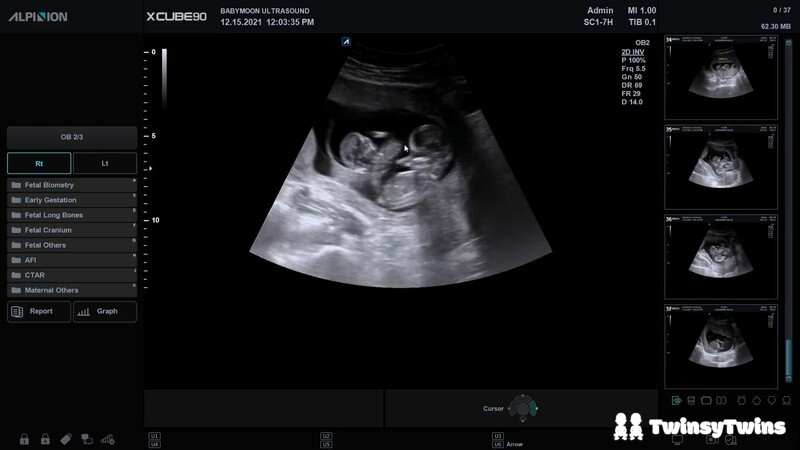
When multiple placentas fuse into one, they can look like one continuous organ on your scans. Because of this, a fused placenta in a Di-Di pregnancy can sometimes be confused for a single shared placenta, which would, of course, mean you have a monochorionic, or Mo-Di, pregnancy.
To differentiate between a fused placenta and a shared placenta, doctors can review the sonograms from your first-trimester ultrasounds. They look at the structural set-up between 10 and 14 weeks' along and evaluate how the dividing membranes connect to the placental tissue to determine if there are multiple placentas that have grown together and merged into one mass.
With a fused placenta, the membrane connection is thick and has a triangular wedge of tissue that grows up into the base of the dividing membrane. It'll have a telltale "Lambda" or "Twin Peak" sign and is made up of four layers (two amnions and two chorions).
A shared placenta, on the other hand, has a thin membrane that's made up of just two amnion layers. It'll have a classic "T" sign specialists will recognize, where the dividing membrane meets the placenta at a 90-degree angle.
If you don't go for an ultrasound during the first trimester, it can be more difficult for specialists to see the difference between the Twin Peak and T signs because the placenta flattens out as your pregnancy progresses.
In this case, the medical team can differentiate between a fused or shared placenta by looking at the fetal sex and their amniotic fluid levels.
In this case, the medical team can differentiate between a fused or shared placenta by looking at the fetal sex and their amniotic fluid levels.
If the babies are confirmed to be different sexes (one boy and one girl), then the placenta must be fused because fraternal (non-identical) twins always have separate placentas. They do not ever share one placenta.
When evaluating the babies' amniotic fluid, specialists will notice if blood is flowing unevenly and causing Twin-to-Twin Transfusion Syndrome (TTTS). When this happens, one baby will have too much fluid and the other one will have nearly none. TTTS only happens with a shared placenta because it has interconnected blood vessels.
A fused placenta doesn't have deep vascular connections like a shared placenta does, which means it cannot cause TTTS. So, if your babies are diagnosed with TTTS, that means they have a shared placenta and not a fused one.
Doctors can definitively determine whether your placenta is fused or not after your babies and placenta have all been delivered.
They can examine the organ by peeling back and counting the dividing membrane layers, or they can inspect the vessels to see if blood flows between two systems (as they would with a shared placenta) or if there are two totally independent vascular pathways (as you'd see with a fused one).
Can a fused placenta happen with both fraternal and identical twins?

Yes, a fused placenta can happen in both fraternal and identical twin pregnancies, as long as the embryos embed close enough together in the uterine wall AND each develop their own placental tissue.
With identical twins, this means they have to be Di-Di twins. In order to be Di-Di, the zygote needs to have divided very early on—between one and three days after conception. If it divides after four days, they will be Mo-Di twins who have one shared placenta, but if it splits before that day-four mark, each baby can develop their own placenta.
With fraternal twins, each baby always has its own placenta, so if they implant close enough to each other in the uterine wall, their separate placentas could grow into one another and fuse into one larger mass.
A fused placenta in triplet and quadruplet pregnancies
A fused placenta in a triplet or quadruplet pregnancy can happen when separate individual placentas (two or three or four, depending on the babies' set-up and whether they're Di-Di, or Tri-Tri, or Tetra-Tetra), implant close together and grow into one large single mass as the pregnancy progresses.
Like with a twin pregnancy, it's easier to decipher between a shared or fused placenta earlier in the pregnancy, when you can look for the usual signs during first-trimester ultrasounds.
...a triplet or quadruplet pregnancy with a fused placenta takes up an even larger surface area on the uterine wall, which means your uterus stretches even more quickly and could potentially cause preterm labor.
Unlike a twin pregnancy, a triplet or quadruplet pregnancy with a fused placenta takes up an even larger surface area on the uterine wall, which means your uterus stretches even more quickly and could potentially cause preterm labor.
If you're carrying triplets or higher-order multiples and have a fused placenta, your maternal-fetal medicine team with monitor you and your babies closely and keep a watchful eye on your cervical length, fetal growth, and fluid levels to determine when it's time to deliver your babies (and your placenta).
Does having a fused placenta make my twin pregnancy high-risk?

Not on its own. If your twins are Mo-Di, that's more high-risk than a Di-Di pregnancy because when your twins share a placenta, there's a risk of uneven sharing of nutrients and blood flow between your babies.
But a fused placenta has separate vascular networks between the two placentas, even though they've merged and fused into one organ. This means that each baby still has their own separate blood supply, which means you don't have to worry about shared-placenta complications, like TTTS.
Having said that, just because a fused placenta isn't considered "high-risk" doesn't mean there are zero risks associated with it.
Risks to monitor when you have a fused placenta

Those who have fused placentas have a slightly higher risk for fetal growth restriction. When two placentas fuse together, they don't always divide and share the space evenly.
Because the placentas are pushed up right against one another, it can sometimes cause the babies' umbilical cords to implant abnormally (marginal insertion or velamentous cord insertion) or it can cause your babies to share the womb space unevenly. This can result in one baby growing a little more slowly than their counterpart, which could be a cause for early delivery of your babies.
Babies who have a fused placenta also have a slightly higher risk of being admitted to the neonatal intensive care unit. This is because of the chance of fetal growth restriction and the potential for preterm delivery.
Mothers who have a fused placenta have a lower risk of developing preeclampsia compared to those who have separate placentas. A study that looked at the outcomes of dichorionic twin pregnancies with fused versus separate placentas as determined on first-trimester ultrasound found that "patients with fused placentas had a lower risk of preeclampsia but a higher risk of fetal growth restriction and admission to the neonatal intensive care unit. In addition, pregnancies with fused placentas were more likely to have a total placental weight below the 10th percentile than those with separate placentas."
Another risk of having a fused placenta is postpartum hemorrhage. This is because once the placenta is detached and delivered, it leaves an exceptionally large wound site on the wall of your uterus. And because your uterus was stretched so much from the fused placenta, it can have trouble contracting down, which can cause hemorrhaging.
To reduce the chance of postpartum hemorrhage, your medical team might give you a medication, like pitocin, to help your uterus contract after delivery.
Don't fret over a fused placenta
A fused placenta isn't something to lose sleep over. It's quite common in a multiple-baby pregnancy, and a twin or higher-order pregnancy can carry on as normal with a fused placenta and usually results in the safe delivery of your babies.
If you have any concerns or questions about your placenta(s) and if they're fused, bring them up with your doctor.
Of course, you should keep up with your regular OB-GYN and maternal-fetal medicine appointments, so your medical team can closely monitor your babies' growth and ensure they're receiving enough nutrition.
If your doctor or maternal-fetal medicine team was unable to determine if you have a shared or fused placenta before delivery, they can do a postpartum evaluation of your placenta to definitively determine whether you had two separate organs that fused together or just one placenta that was shared between your babies.
Did you have a fused placenta? How did your medical team determine it was fused and not a shared placenta? Let us know in the Comments section below or connect with us on Instagram to share your thoughts!
Read more

New Partnership Advocates for Better Mental Health Support for New Parents
No matter how you look at it, parenting is stressful. Beyond keeping one or more tiny humans alive, the extreme sleep deprivation and financial strain of keeping multiple mouths fed and the associated butts clean and dry don't make anything easier. Add to that the potential trauma that can come with a multiple-birth delivery and the relationship strain that comes over time with never...

Predicting Preeclampsia: New Prenatal Screening System is a Game-Changer
Preeclampsia is a serious condition that affects between two and four percent of singleton pregnancies and between nine and 11 percent of twin pregnancies. This means a twin pregnancy presents a risk of developing preeclampsia that is approximately two to three times higher than a single-baby pregnancy. The likelihood of Preeclampsia developing is nine to 10 times more likely at...

Glossary of NICU Medical Terms & Acronyms for Parents of Premature Babies
When you become a parent to premature babies, you also become someone who's taking a crash course in specific medical terms for infant care. The neonatologists and pediatric nurses in the Neonatal Intensive Care Unit (NICU) will use many different terms you may not understand when discussing your babies' medical conditions and the specialized care they're receiving. Sometimes, it can...

The Shadow Sibling: Understanding & Healing from Vanishing Twin Syndrome
If you're expecting twins or higher order multiples, your pregnancy is automatically higher-risk than a singleton pregnancy. A multiple pregnancy is considered high-risk for many reasons. When you're carrying more than one baby, there are more babies on board, more things to monitor, and more ways things can go wrong. And if they go wrong, they can go wrong very quickly, which is why...