

We may earn a commission for purchases using our links. Learn more.
When you're blessed with a set of twins, you're also blessed with a set of schedules to fit into their wake windows.
Feeding schedules.
Pumping schedules.
Tummy time schedules.
Napping schedules.
More than it seems you can fit in before it's time for them to lay down again.
And when you have to add dual medication schedules into the mix, it can all begin to feel a little chaotic.
Like you're on a daily loop of I Love Lucy—the one where she and Ethel are frantically trying to stay on top of production at the chocolate factory.
When both of your babies are sick at different times and on potentially different schedules, it can become very hard to keep track of who's had which medication and when.
And while twins automatically come with a lot of doubles, the last thing you want to do is give one of your twins a double-dose of medicine by accident.
And when your twins look identical to each other, it gets that much more tricky to stay on top of it all.
Make it easy
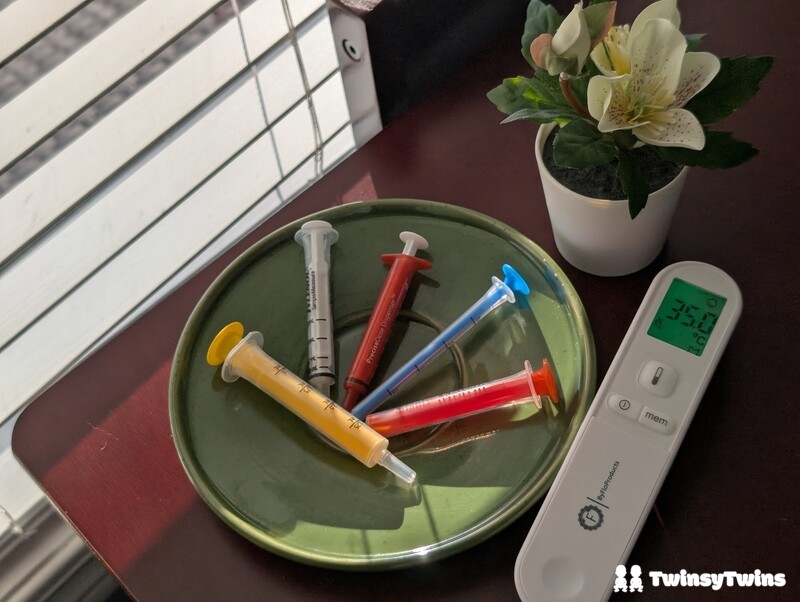
The absolute easiest way to keep track of medication schedules with your twins, whether they're on the same schedule or differing ones, is to write it down.
Even if you think you'll remember, just take the 20 seconds to jot it down, anyway, because you might need to give a rundown to another caregiver and it'll be easiest for them to be able to reference your note, if needed.
Make a note on your phone and always write down which twin had which medicine and at what time. You can even make it a shared note with your partner or another primary caregiver, so they readily have access, if needed, to see who needs what and when.
It's generally pretty easy to keep track of if both twins are unwell and are on the exact same medication and dose schedule. But when time blends together in those early days with your newborns, it can be hard to remember with absolute certainty when you last gave a dose.
And if you've got twins who are taking, say, a dose of Infant Tylenol but their dose schedules are three hours apart because they got sick at different times, you don't want to accidentally give a dose to the wrong baby at the wrong time.
Or, if Tylenol isn't cutting it and you choose to add Infant ibuprofen into the mix, then you've suddenly got two babies, two medications, and four different dose schedules to keep track of, and it can get confusing quickly.
On top of that, if your twins were born prematurely (as most twins are), they might also need to be on a daily vitamin regimen (our twins had Trivisol prescribed by their pediatrician, so that and iron drops, which were also prescribed by their doctor, were added into their morning feed every day, along with their daily administration of vitamin D drops.
Eliminate stressful schedules

With our twins, it was stressful making sure everybody got all of their medicine and vitamin doses on schedule day-in and day-out—and that you didn't accidentally double-dose anybody unintentionally.
Setting alarms for when it was time for the next doses to be given, combined with having a concrete list to look back on in the moments of excruciating exhaustion that accompanies the first five months with your dynamic duo, can give you peace of mind that everybody is taken care of and has what they need when they need it.
As an added bonus, if your twins end up needing to see their pediatrician over the course of their illness, you'll have an extensive and precise list to show them, so they can quickly see how often your twins have needed medication and when they've had it last.
Do you have any tricks you use to keep track of different medication schedules with your twins? Let us know in the Comments section below or connect with us on Instagram to share your thoughts!
Read more

Essential Audiobooks Every Parent Should Check Out
As a parent, you have probably told yourself tons of times that you're going to read more on a certain subject or take the time to look something up when you get a few spare minutes later this week. And as a busy parent to multiple children who's running all over town to daycare drop-off, after-school pick-up, or a handful of extracurricular activities throughout the week, you probably...

Why Premature Babies Face Greater RSV Risks: What Twin Parents Need to Know
Like clockwork, flu and RSV seasons have arrived. They'll continue to run rampant from late fall through early spring. Some respiratory viruses even continue circulating into May, but the worst of these viruses peak during the winter months. If your babies were born prematurely...they're at a higher risk of adverse outcomes from respiratory illnesses. If your babies were born...

Corneas, Curves & Preemies: The Link Between Early Delivery & Astigmatism
Eyesight is a precious thing. So are premature babies. Did you know that prematurity can impact the long-term vision health of your babies? About 60 percent of twins—and the vast majority of higher-order multiples–are born early, before they're finished developing in the womb. If your babies need to spend time in the neonatal intensive care unit (NICU), healthcare professionals help...

50 Fantastic Amazon Prime Day Deals for Parents of Twins & Multiples
Prime Day deals are back, baby! You might be wondering if Prime Day deals are worth it when you have twins and have to buy multiples of a lot of things. We're here to tell you they are. Here are 50 items that actually pay off…as long as you get them before they're gone! Here are 50 items that actually pay off…as long as you get them before they're gone! First, make sure you've...