

If you have allergies, you know how difficult it can be to navigate life without accidentally ending up in the emergency room.
If you have children with allergies, the fear of encountering allergens unexpectedly is compounded because your little ones may not be able to communicate to you that something is wrong.
And, if you find yourself with a set of twins who happen to be allergic to the same thing, that fear is instantly doubled.
It's important to note that twins may not necessarily share the same allergies.
Fraternal twins have a lower likelihood of sharing allergies, as they're siblings who are born at the same time and share a lower percentage of familial DNA. Even identical twins, who share the same DNA, may not have shared allergies, thanks to the environmental factors at play.
Different gene expression, different gut bacteria, different diets, different illnesses, even different birth methods (vaginal vs. C-section—and both can happen when you're birthing twins) can all impact the development of an allergy. These different experiences can result in one twin becoming allergic to, say, peanuts, while the same allergy is not activated in the other twin (around 60 to 70 percent of twins share this particular allergy).
Whether one or both of your twins is affected, when you have food allergies, you have to be vigilant every day, every meal.
...when you have food allergies, you have to be vigilant every day, every meal.
More often than not, it's easier to just stay at home instead of going out to eat, where there's an increased risk of coming into contact with triggering ingredients or for cross-contamination to occur.
Around the world, 250 million people live with food allergies, and it's a growing issue, with cases increasing by about 50 percent over the last 15 years. About eight percent of children and 10 percent of adults are affected by food allergies.
Fifty percent of severe reactions occur outside of the home, with nine allergens (peanuts, tree nuts, milk, eggs, fish, shellfish, wheat, soy, and sesame) accounting for 80 percent of allergic reactions.
Now, a new device can help those with food allergies to detect the presence of allergens with ease.
Detect food allergens with precision
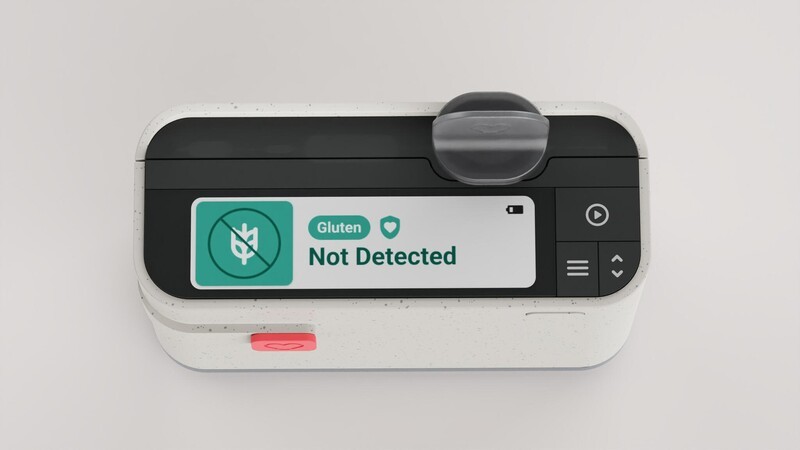
Unveiled at the Consumer Electronics Show in Las Vegas, NV earlier this week, Allergen Alert is an innovative start-up specializing in the rapid detection of food allergens for individuals and professionals.
The company has developed a portable, fast, and reliable solution that can identify the presence of allergens and gluten in food in just a few minutes.
This is a huge step forward in food safety for those with allergies or who suffer from celiac disease. It's currently being used by Michelin-star restaurants and is set to be available for pre-order to the public later this year.
This is a huge step forward in food safety for those with allergies or who suffer from celiac disease. It's currently being used by Michelin-star restaurants and is set to be available for pre-order to the public later this year.
This first portable device can detect allergens or gluten directly in a meal with laboratory-level precision. Unlike barcode scanners or apps attempting to interpret a photo of a dish, this pocket-sized mini-lab relies on a patented, single-use pouch derived from bioMérieux's laboratory technologies, which miniaturizes and automates every step of a professional analytical test.
It's compact and portable, and it enables people with food allergies or celiac disease to test their food autonomously, wherever they are.
An extra layer of protection

Beyond double- and triple-checking ingredient lists and labels, and having continual conversations with restaurant staff, this innovative device gives people an extra layer of protection powered by qualitative data.
This mini lab allows anyone to test their own meal, in real conditions, right before eating, using immunoassay technology that has—until now—been reserved for professional laboratories.
This lightweight, battery-powered device allows you to analyze a calibrated, representative food sample that you've placed inside a single-use pouch. In mere minutes, the result clearly indicates whether an allergen or gluten is present, so you and your family can dine with confidence, no matter where you are.
"The number of people with food allergies has increased by 50 percent over the last 15 years. It's a growing public health issue," explains Bénédicte Astier, CEO of the start-up, who envisioned this device after her young daughter suffered from anaphylactic shock from a severe allergy.
"Allergen Alert offers an innovative, preventive solution, reducing the risk of exposure and thereby improving the quality of life for persons with allergies or suffering from celiac disease."
Thanks to an exclusive technology license from bioMérieux, a global leader in in-vitro diagnostics with over 60 years of expertise in clinical microbiology and infectious disease testing and also a major player in food safety, this innovative, pocket-sized device analyzes a food sample and quickly gives users a result via its smartphone app.
Not only can this compact instrument help restaurant owners ensure food safety for customers, it can also directly give consumers peace-of-mind when choosing to dine away from home.
This portable mini lab was developed in collaboration with allergists, emergency physicians, allergy patients, patient representatives, and experts in both food safety and catering.
Have you had to navigate food allergies with your children? Would a device like this one make it easier to eat meals in a public setting? Let us know in the Comments section below or connect with us on Instagram to share your thoughts!
Read more

Breastfeeding Twins: Six Fascinating Facts Every Parent Should Know
Breastfeeding one baby can feel intimidating. But when you find out you're carrying more than one baby, the pressure of feeding two newborns simultaneously might make you doubt your milk supply and whether you'll be able to produce enough for two tiny, little humans. You may also wonder whether you'll have the energy to handle breastfeeding twins physically (we're talking double the...

Fueling Your Preemies: How Feeding Tubes Support Your Tiny Twins’ Growth
When you welcome your babies into this world, there are many ways they can be fed, from breastfeeding, to bottle feeding, to a combination of the two. But when your newborns aren't able to feed from the breast or a bottle or they can't get enough calories through regular feeding methods, they may need a feeding tube in order to gain weight. What are feeding tubes? Feeding tubes are...

Double the Bottles, Half the Wait: These 3 Dual Bottle Warmers are Great
If you've ever suddenly been hit by a pang of hunger and then realized you need food NOW, you're familiar with how your newborn twins are feeling when they're trying to communicate to you that they're ready for their next feeding. Except that they can't talk yet, so they communicate in the only way they know how—by screaming at their caregivers at the top of their lungs until they get...

What is a Feeding Tube & Why Does My Baby Need It?
If your babies were born prematurely, chances are good they'll need to spend some time in the neonatal intensive care unit (NICU). As a parent, it can be difficult to walk into the NICU, make your way to your newborns' cribs, and see there are various wires connected to them to monitor their vital stats. Among the accoutrements that weren't adhered to your babies mere moments ago when...